

Last spring I got a message from a reader that stuck with me. “Your article on budget mirrorless cameras is the top source in ChatGPT’s answer,” he wrote, “but I never saw it in my Google results page. How does that even work?”
I checked, and he was right. A post of mine was being cited by an AI assistant, with my site name attached, while my traffic for that same page had been slowly sliding for months. Rankings were fine. Clicks were not. That was my first real encounter with Generative Engine Optimization.
That was the moment I stopped treating “AI search” as a thing other people were writing think pieces about. People were getting answers without ever visiting a website, and my content was part of those answers. I wanted to know why some pages get pulled in and others get ignored.
This is what I’ve learned since, including the experiments that went nowhere. Some of it is still uncertain, and I’ll say so when it is.
So What Is GEO, Actually?

Generative Engine Optimization is the practice of making your content easy for AI systems to find, understand, and cite when they generate answers. Those systems include Google’s AI Overviews and AI Mode, ChatGPT search, Perplexity, Gemini, Copilot, and similar tools.
Traditional SEO asks, “How do I rank in the list of blue links?”
GEO asks, “How do I become part of the answer itself?”
Nobody has a full rulebook for this, and anyone selling you one is overselling. These systems change often, and the companies behind them don’t publish exact ranking logic. What we have is a mix of official guidance, observation, and a lot of testing by people in the field.
Is This Replacing SEO? Not Really

I see a lot of “SEO is dead” posts, and they annoy me.
From what I’ve seen, GEO sits on top of SEO rather than replacing it. Many AI search features lean on traditional search indexes and retrieval, so pages that are crawlable, fast, trustworthy, and relevant still have a big head start. Google has also said publicly that its AI features follow the same fundamentals as regular search, with no special secret markup required.
If your site has broken technical basics, thin content, or no real authority, no amount of GEO tricks will rescue it. I learned that by testing GEO tactics on a weak site first and getting nothing.
What changes is the goal. A click is no longer the only win. Sometimes the win is being named, quoted, or recommended in a response. That’s a different kind of visibility, and it needs a slightly different mindset.
How I Started Testing This

I didn’t buy anything fancy at first. I made a list of 30 questions my readers actually ask, things like “best budget laptop for students” and “how to back up photos from a phone,” and ran each one through ChatGPT, Perplexity, Gemini, and Google’s AI Overviews. I logged what each one said, which sources it cited, and whether my site showed up.
It was tedious. I used a plain Google Sheet with columns for the question, the platform, whether I was cited, who was cited instead, and notes.
Some patterns showed up quickly:
– The cited pages were often not the number one result in regular Google.
– Pages that answered the question directly near the top were cited more often than pages that buried the answer.
– Forum threads, Reddit discussions, YouTube videos, and review sites appeared way more than I expected.
– Different AI tools cited very different sources for the same question.
That last point matters. There isn’t one “AI ranking.” Each platform behaves differently, and results can change from one day to the next. Treat any single snapshot as a rough hint, not a verdict.
What Seems to Help (Based on What I’ve Seen)

Here’s what has worked for me or what I’ve seen work for other site owners. I’m labeling these as observations, not guarantees.
1. Answer the question early and plainly
Many of my old articles opened with a long personal story before getting to the point. Readers sometimes liked that, but AI systems pulling a quick answer had nothing clean to grab.
I went back and added a short, direct answer of two or three sentences near the top of key posts, then kept the story and detail below. The reader still gets the full article, and the answer is easy to find.
2. Write in a way that stands alone
A snippet pulled out of context should still make sense. If a paragraph says “as mentioned above, this one is better,” it’s useless on its own. I started rewriting key sections so each one names the thing it’s talking about and makes a complete point.
3. Add something that isn’t already everywhere
This is the big one. If your article says what ten other articles say, there’s no reason for an AI system to prefer yours.
I started adding things only I could add: my own test results, photos of the actual device, specific problems I ran into, and measurements. For a laptop review, that meant noting that the fan got loud when exporting a video, not just repeating the spec sheet.
Original experience, data, and opinions give a system something unique to cite.
4. Show who you are
I rewrote my author bio to explain why I’m qualified to write about the topic. I added a real About page, a way to contact me, and dates on my articles. None of this is magic, but it lines up with the trust signals Google keeps talking about in its quality guidelines, and it makes a site feel like it’s run by an actual person.
5. Keep structure clean
Clear headings, short paragraphs, tables for comparisons, and lists where they make sense. This helps people skim and also makes it easier for machines to parse what each section covers.
I also check that important content isn’t hidden behind tabs, scripts, or pop-ups that a crawler might not render.
6. Use structured data where it fits
Schema markup, such as Article, FAQ, Product, and Review where appropriate, helps search engines understand a page. I wouldn’t treat it as a GEO cheat code, because I haven’t seen proof it directly causes AI citations. But it’s good hygiene, and it costs little.
7. Don’t block the crawlers you want
Check your robots.txt. I once found that a security plugin had been blocking several bots I didn’t know about. Whether you want AI crawlers to access your content is a business decision, since some publishers block them on purpose. Just make that decision deliberately instead of finding out by accident.
8. Build a presence beyond your own site
This was my biggest surprise. AI answers often draw on discussions and mentions from across the web, not just from publisher pages. When people talk about your brand or your work in forums, on YouTube, in newsletters, or in other articles, that seems to matter.
I started answering questions in communities where I could genuinely help, without dropping links everywhere. Being useful in public is slow, but it builds the exact kind of reputation that naturally fuels Generative Engine Optimization and carries right into AI answers too.
A Simple Step-by-Step Process You Can Try This Week
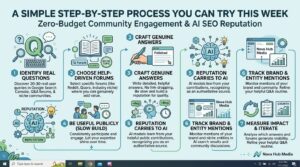
You don’t need a big budget. Here’s the routine I’d follow if I were starting fresh.
Step 1: List 20 to 30 real questions. Use Google Search Console to see what queries already bring impressions. Add questions from reader emails, comments, and forums.
Step 2: Test them. Run each one through two or three AI tools. Note whether you’re cited, who else is, and what kind of sources they are (blogs, forums, videos, brand sites).
Step 3: Pick five pages to improve. Choose pages that already get some traffic or are close to ranking well. Improving a page that’s already close tends to pay off faster than rewriting something with no foundation.
Step 4: Rework those pages. Add a clear direct answer near the top. Break up long blocks. Add original details, such as your own tests, photos, or numbers. Update outdated information and show a “last updated” date.
Step 5: Fix the basics. Check page speed, mobile layout, internal links, and whether the page is indexed.
Step 6: Re-test in a few weeks. Run the same questions again and compare. Expect noise. Look for trends over a month or two, not day-to-day changes.
Step 7: Track the right numbers. Watch branded searches, direct visits, referral traffic from AI tools (it often shows up in analytics from sources like chatgpt.com or perplexity.ai), and conversions, not just rankings.
Tools Worth Knowing About
You can do a lot with free tools:
- Google Search Console for queries, impressions, and indexing problems
- Google Analytics (GA4) to spot referrals from AI platforms
- A plain spreadsheet for manual citation tracking
- The AI tools themselves since testing prompts yourself teaches you more than any report
Paid options exist if you’re managing many pages or clients. Semrush and Ahrefs have both added AI visibility features, and dedicated tools like Profound and Otterly.ai focus on tracking brand mentions in AI answers. They’re useful for monitoring at scale, but I’d try the manual method first so you understand what you’re measuring. These tools also change fast, so check what’s current before paying.
Mistakes I Made (So You Don’t Have To)

I chased every tactic I read about. For a while I was reformatting posts based on whatever someone on social media claimed “AI loves.” Most of it had no visible effect. Stick to changes that also make the page better for humans.
I tried to write for machines. One batch of posts ended up stiff, over-structured, and boring. Traffic from regular readers dropped, and the AI citations didn’t improve. Write for people first.
I created an llms.txt file and expected miracles. There’s been a lot of buzz around adding an llms.txt file to a site. I added one, and I saw no measurable change. Whether any major AI platform meaningfully uses it is, as far as I can tell, still unproven. It’s harmless to add, but don’t count on it.
I over-trusted a single test. I once celebrated getting cited in ChatGPT, then couldn’t reproduce it the next day. AI responses vary. Run tests multiple times and look at patterns.
I published thin AI-written content to “cover more topics.” It backfired. The pages added nothing original, didn’t get cited, and dragged down the overall quality of the site. Using AI as a helper is fine, but publishing generic filler isn’t a strategy.
I ignored the click problem. Getting cited doesn’t always mean getting traffic. In some cases, being cited sends a trickle of visitors, and in others people read the answer and leave. That’s why I now focus on building something readers want to come back to, like a newsletter, tools, or strong opinions, instead of relying on one-off clicks.
A Real Example From My Own Site
One post on setting up a home backup system was ranking decently but never showed up in AI answers because it lacked proper Generative Engine Optimization. It was a long, rambling piece that opened with a story about losing a hard drive.
I made four changes. I added a three-sentence summary at the top that answered “what’s the simplest reliable backup setup.” I added a comparison table of three approaches with costs and tradeoffs. I included a section on the mistake I made, which was trusting a single external drive. And I updated every outdated product mention.
Over the next couple of months, I started seeing the page cited in Perplexity and occasionally in Google’s AI results for related questions. I can’t prove those edits caused it, because too many things change at once. But the page also became better for human readers, and time on page went up. That’s why I keep recommending this kind of improvement. You win either way.
What I Think Happens Next
Nobody knows exactly where this goes, and I’d be suspicious of anyone who claims otherwise. But some things seem likely.
AI answers will keep taking up more space in search results, which means fewer easy clicks for generic information. Sites that offer something distinctive, like first-hand experience, original data, community, and a recognizable voice, will probably hold up better than sites that summarize what everyone else already said.
Brand will matter more. When people (and AI systems) recognize a source as reliable on a topic, that recognition compounds.
And the boring fundamentals will still matter: fast sites, clear writing, honest information, and real expertise.
Final Thoughts
When that reader’s message first landed in my inbox, I felt a bit of panic. Now I mostly feel curious. Search is changing with Generative Engine Optimization, but the core job is the same one it’s always been: be the most helpful, trustworthy place to get an answer on your topic.
If you do only three things after reading this, make them these. Test how AI tools answer the questions your audience asks. Improve a handful of your best pages with clear answers and original detail. And invest in being a source people actually trust, not just one that’s easy to scrape.
Don’t expect overnight results, and ignore anyone who guarantees them. Run small experiments, keep notes, and adjust. That approach has worked better for me than any “secret formula” I’ve come across.
